AXIS 0288-001-01 Video Encoder Analog Ip Network Poe Q7401 1-CHANNEL
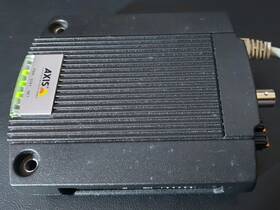
( Brand: Axis ), ( Manufacturer Part Number: 0288-001-01 ), ( Model: AXIS-Q7401 ), ( Part Type: Video ), ( Country Of Origin: Thailand )
Review AXIS Video Encoder Analog To Ip Network Poe 1-channel
The **Axis Q7401** is a compact yet highly capable **1-channel analog-to-IP network video encoder**, designed to seamlessly bridge traditional analog surveillance systems with modern digital networks. Part of Axis Communications robust Q7400 series, this encoder (model **0288-001-01**) is engineered to deliver high-performance video conversion while maintaining exceptional reliability, making it an ideal solution for both new installations and retrofitting existing analog CCTV infrastructures. With built-in **Power over Ethernet (PoE)**, the Q7401 eliminates the need for separate power supplies, simplifying installation and reducing cabling complexity in environments where electrical outlets may be scarce. This encoder supports **analog inputs** (PAL, NTSC, or SECAM) and converts them into **H.264/H.265 compressed video streams**, ensuring efficient bandwidth usage and high-quality playback across IP networks.
The device features a **single-channel analog input**, accommodating standard **CCTV cameras** (e.g., BNC or coaxial connections) and enabling seamless integration with legacy systems. Its **10/100 Mbps Ethernet port** ensures stable connectivity, while **PoE (IEEE 802.3af/at compliant)** provides power delivery (up to **15.4W**), allowing for flexible deployment in areas where power access is limited. The Q7401 supports **multi-stream encoding**, enabling simultaneous delivery of **main, sub, and auxiliary streams** at different resolutions and frame rates, catering to diverse monitoring needs from high-definition surveillance to lower-bandwidth applications. With **adaptive bitrate (ABR) streaming**, the encoder dynamically adjusts video quality based on network conditions, ensuring smooth playback even under fluctuating bandwidth conditions.
Security and ease of management are central to the Q7401 s design. It incorporates **Axis secure boot and firmware validation** to prevent unauthorized modifications, while **TLS 1.2 encryption** protects video streams from interception. The encoder integrates with **Axis Camera Management (ACM) software**, **VMS platforms**, and **third-party solutions** via **ONVIF Profile S**, simplifying deployment and centralized monitoring. Its **compact, rugged housing** (IP40-rated) ensures durability in various environmental conditions, making it suitable for both indoor and outdoor applications. Additionally, the Q7401 supports **motion detection, audio input, and digital I/O**, enhancing its versatility for advanced surveillance setups. Whether deployed in commercial buildings, industrial facilities, or public safety applications, this encoder delivers a **reliable, scalable, and future-proof** transition from analog to IP-based video surveillance.
### **Pros and Cons of buying a Axis Q7401 Video Encoder (Axis 0288-001-01)**
#### **Pros:**1. **High-Quality Video Encoding**
The Q7401 supports H.264 and H.265 (HEVC) encoding, providing efficient compression while maintaining good image quality. This ensures smooth streaming and lower bandwidth usage compared to older codecs.
2. **Analog to IP Conversion**
It converts analog CCTV signals (PAL/NTSC) into IP-based streams, making it easy to integrate legacy analog cameras into modern IP surveillance networks without replacing the entire system.
3. **PoE (Power over Ethernet) Support**
The device supports Power over Ethernet (IEEE 802.3af/at), simplifying installation by eliminating the need for separate power cables. This reduces clutter and makes deployment easier in existing networks.
4. **Single-Channel Flexibility**
As a 1-channel encoder, it is ideal for small-scale deployments where only one analog camera needs to be converted to IP. This makes it cost-effective for single-camera setups or as a backup solution.
5. **Low Latency Streaming**
The encoder provides real-time or near-real-time streaming, which is useful for applications requiring live monitoring without significant delay.
6. **Compatibility with Axis and Third-Party Systems**
It integrates well with Axis cameras and other IP surveillance systems, including VMS (Video Management Software) solutions like Axis Camera Station, Milestone, or Genetec. This ensures compatibility with existing infrastructure.
7. **Compact and Rugged Design**
The device is designed to be durable and space-efficient, making it suitable for indoor and outdoor installations where space is limited.
8. **Motion Detection and Alerts**
The encoder supports motion detection and can trigger alerts or record events based on predefined settings, enhancing security monitoring capabilities.
9. **Easy Installation and Configuration**
The setup process is straightforward, with web-based configuration tools that allow users to adjust settings such as resolution, frame rate, and compression without requiring advanced technical expertise.
10. **Cost-Effective Upgrade Path**
For businesses or users with analog cameras, the Q7401 offers a cost-effective way to transition to IP surveillance without investing in entirely new camera hardware.
---
#### **Cons:**1. **Limited to Single-Channel**
The encoder is designed for only one analog input, which may not be suitable for larger surveillance systems requiring multiple cameras. Users with multiple analog cameras would need multiple units or a multi-channel encoder.
2. **Dependence on Analog Camera Quality**
The output quality is only as good as the analog camera it is connected to. If the analog camera has poor resolution or low light performance, the IP stream will reflect those limitations.
3. **Potential Bandwidth and Storage Requirements**
While H.265 encoding is efficient, streaming high-resolution video (e.g., 1080p) can still consume significant bandwidth and storage, especially if multiple streams are involved. Users must ensure their network and storage infrastructure can handle the load.
4. **Limited Advanced Features**
Compared to dedicated IP cameras, the Q7401 lacks some advanced features such as built-in AI analytics, advanced motion detection algorithms, or high-end low-light performance. These features are typically found in modern IP cameras.
5. **Dependence on Network Stability**
As an IP device, the encoder relies on a stable network connection. Network issues, such as packet loss or latency, can affect video quality and reliability, particularly in remote or poorly managed networks.
6. **Potential Compatibility Issues with Older Systems**
While the encoder supports common analog standards (PAL/NTSC), there may be compatibility issues with very old or non-standard analog cameras. Testing with the specific camera model is recommended before purchase.
7. **No Built-In Recording**
The encoder does not include local storage; it relies on a VMS or external recorder for storing video footage. This adds an additional layer of complexity and cost if recording is required.
8. **Limited Scalability**
For growing surveillance needs, the Q7401 may quickly become insufficient. Users may need to invest in additional encoders or transition to a fully IP-based system in the future.
9. **Dependence on Third-Party Software for Full Functionality**
To utilize advanced features such as remote viewing, playback, or analytics, users must rely on third-party VMS software, which may incur additional licensing costs.
10. **Potential Security Risks**
Like all IP devices, the Q7401 is vulnerable to cybersecurity threats if not properly secured. Users must implement strong passwords, network segmentation, and regular firmware updates to mitigate risks.
---
### **Ending Conclusion:**The **Axis Q7401 (0288-001-01)** is a practical and cost-effective solution for converting a single analog camera into an IP-based system. It excels in scenarios where legacy analog cameras need to be integrated into modern surveillance networks without replacing the entire infrastructure. Its support for H.264/H.265 encoding, PoE, and compatibility with various VMS systems makes it a versatile choice for small-scale deployments or as a temporary upgrade solution.
However, its single-channel limitation, dependence on analog camera quality, and lack of advanced features like AI analytics or built-in recording may make it less suitable for large-scale or high-end surveillance systems. Users should carefully assess their needs, network infrastructure, and long-term goals before purchasing. If the primary goal is to modernize a single analog camera with minimal disruption, the Q7401 is a solid choice. For more complex or scalable systems, investing in dedicated IP cameras or multi-channel encoders may be more appropriate.
---
### **Recommendation:** - **Buy the Axis Q7401 if:**- You have a single analog camera that needs to be converted to IP.
- You want a simple, cost-effective way to integrate legacy cameras into a modern network.
- Your network infrastructure can support the bandwidth and storage requirements of the IP stream.
- You are using it as a temporary solution or for a small-scale deployment.
- **Consider alternatives if:**- You need to support multiple cameras simultaneously (opt for a multi-channel encoder or dedicated IP cameras).
- You require advanced features such as AI analytics, high-resolution low-light performance, or built-in recording.
- Your surveillance needs are expected to grow significantly in the near future.
- You are working with very old or non-standard analog cameras that may not be fully compatible.
For users who are unsure about their long-term needs, it may be wise to consult with a surveillance specialist to determine whether the Q7401 aligns with their goals or if a more scalable solution is required.
Details:
Test unit - Unit has been bench tested and updated with most recent firmware for the device. Axis Q7401 single-channel video encoder designed to convert analog CCTV into a digital IP stream for modern network surveillance systems.
part #: 028800101 prices
- $25.00-$145.00
specifications securityretaili:
- brand: Axis
- mpn: 0288-001-01
- model: Axis-q7401
- part type: Video
- country of origin: Thailand
offer securityretaili:
- best offers: True
- started: April 14, 2026
- quantity: 0
- availability: In Stock
- sold: 1
- options: Ship-to-home
general securityretaili:
- condition: Seller refurbished
- Retail Services > Security Surveillance > Camera Video Systems
shipping securityretaili:
- carrier: USPS
- cost: $6.15
- type: Fixed
- service: USPS Ground Advantage
- class: Standard
- transit: 6-9 Days
returns securityretaili:
- policy: No Returns
seller securityretaili:
- city: Lafayette, Louisiana
- # reviews: 193
- rating: 100.0%
payments securityretaili:
- wallet: Google-pay
- other
- credit card: Diners-club
Axis 0288-001-01 Is Similar To:
- 0288-041 Axis Communications Video Encoder Server 012304212980 (43.3% similar) 5MM x 1 audio output ports mini-phone. 5MM x 1 alarm ports input 4, output 4 camera control interface putz rs network port Axis communications inc. 65 pounds size:n item DIMENSIONS:3...(September 21st, 2018)
- 0321-002 Axis Network Audio Module Security Surveillance 031111127508 (28.4% similar) 85 pounds size: n item DIMENSIONS:1...(November 15th, 2018)
- 0939-004 Axis Network Video Recorder Security Surveillance 7331021054813 (26.4% similar) ...(April 26th, 2018)
- 0953-001 Axis Communications Mk Ii Network Camera Color 779184161042 (35.7% similar) Product features P3225-VE Mike 1080P dome HD recording: yes color supported: color video formats: motion JPEG. 264MAXIMUM video resolution: 1920 x 1080MINIMUM focal length : 3MM maximum pounds size:n item DIMENSIONS:4. 50MM optical zoom: 87 anarchistic: 42...(April 26th, 2018)
- 7331021038042 Axis Communications Fixed Dome Network Camera 115971175920 (33.3% similar) Mid span not included. Multiple, individually configurable. Ultra-discreet fixed dome camera for recessed mounting in drop ceilings. Video motion detection. 11UPC: progressive scan cms sensor. Power over Ethernet. MPEG-4 part 2 also supported. 264 and motion JPEG streams max VGA 640 x 480 resolution...(July 16th, 2018)
- 922007299-00 Axis Communications Video Server Rack 7331021018693 (27.9% similar) ...(June 22nd, 2018)
- 01033-001 Axis Communication Inc Network Radar Detector 7331021058293 (32.9% similar) As accurate it is robust Axis D2050-VE detects movement and nothing but movement, 24 hours a day...(December 10th, 2018)
- 01061-001 Axis Network Camera Surveillance (37.2% similar) Product highlights 1920 x 1080 resolution at up to 60 FPS3-10MM verifiable LENS90-34 horizontal field of view two-way admixed SOHC Styx slot for edge storage RJ45 Ethernet with poe technology axis zip stream -compliant, profitless GIP66 and Norma 4X-RATED outdoor USEIK10-RATED vandal resistance...(March 21st, 2018)
- 01115-001 Axis Companion Bullet Mini Le Outdoor Full Hd Ir Network (33.6% similar) Please for more. For serious buyers only. Outdoor full HD Ir network camera. Brand new still in sealed box, Axis companion bullet mini Le...(August 14th, 2018)
- 0126-011-02 Axis Network Security Surveillance Camera (29% similar) ...(July 4th, 2018)
- 01489-001 Axis Communication Inc Poe Over Coax Compact 7331021063839 (25.9% similar) Orders usually ship the same day are placed or following...(November 9th, 2018)
